Wednesday, April 9, 2014

Which Sparrow Is That?

Today I strolled through Luria Park, taking the boardwalk, crossing the creek on the rocky muddy trail while the bridge is still under construction, and walking around the path that circles the open field. It was mid-afternoon and bird activity is generally slower in the shank of the day, with the birds spending time in the brush and out of sight. I did manage to find three different species of sparrows that are common to our neighborhood. Here is a primer for telling the difference between them.

First is the Song Sparrow.
This little fellow was taking a drink in the stream near the bridge. You can tell he is a Song Sparrow by the rust-colored streaks on his head and below the eyes. He also has small dots of black below and on either side of his beak. This called the "mustache" or malar stripe.

Second is the White-Throated Sparrow.
This little girl was rifling through leaves by the stream near the playground. The White-Throated Sparrow has two distinctive yellow dots near the top of the beak. There is a white patch below the beak near the "throat." The White-Throated Sparrow has brown on top of the head and grey below. But look for those yellow spots which are very bold on the male and less so as on this female (above).

And third is the House Sparrow.
I found this guy along with his duller mate in a tangle of shrubbery on the south side of Luria Park. The House Sparrow is an introduced species to North America from Europe. The male House Sparrow is identified by gray heads, rufous (brown) sides of the head, and a black bib which also touches his eyes. The House Sparrow is often resented as it can be aggressive and kick other birds out of nests.

So, now you can go out and tell the difference between our most common three area Sparrows!

(all photographs taken n Luria Park on April 9th, 2014)

Why a Raymondale bird blog? Dan and Beth Fedorko have been inventorying birds for Cornell University's Backyard Bird Count (www.feederwatch.org) which runs November through April each year. This inventory keeps track of migratory patterns, possible diseases, and decline and increase in bird populations. In response to the Raymondale Environmental Stewardship Task Force, we have started this blog which is separate from the general Raymondale news blog and more personal, to share our finds and photographs. If you see any birds in the neighborhood and surrounding parkland, please send us a photo! We'll help you identify it and might even post it on the blog!


Red-Bellied Woodpecker

The Red-Bellied Woodpecker enjoys relatively large populations in our area compared to other woodpeckers. If you offer them suet...they will come.

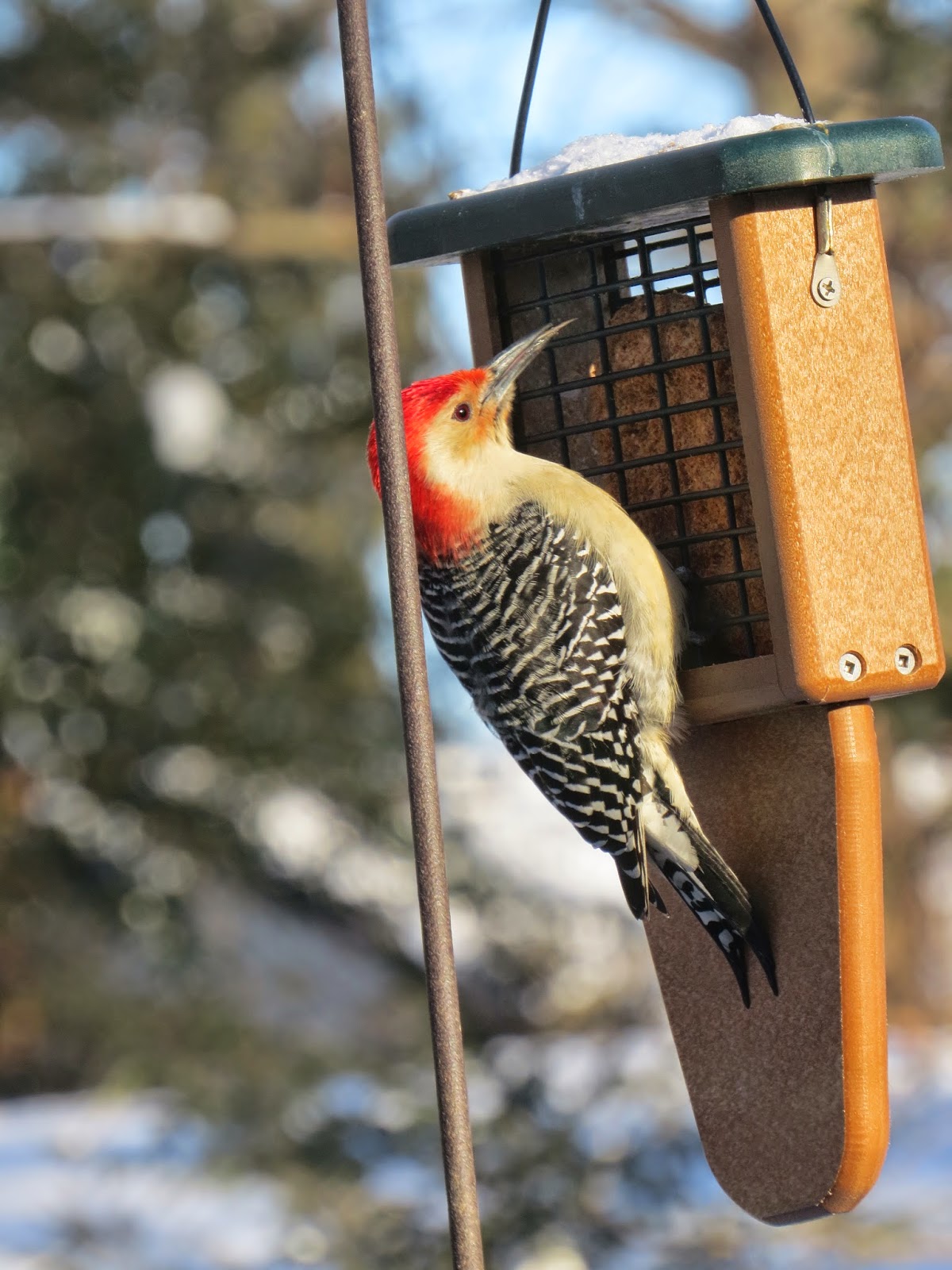
This male Red-Bellied Woodpecker is balancing very skillfully on our paddle suet feeder. You know this bird is a male because the red on top of his head goes from the top of his beak to the back of his neck.

This male Red-Bellied Woodpecker also feels comfortable on a smaller cage style suet feeder despite the fact he is larger than the feeder.

The Red-Bellied Woodpecker will wait patiently for other birds to vacate the feeder before swooping in, but once established there he will guard his position.


Pam Hamby contributed this wonderful photo of a male Red-Bellied Woodpecker staring warily at a chipmunk that has invaded the seed feeder. You can see the red on the bird's belly, hence the name Red-Bellied Woodpecker.

The Red-Bellied Woodpecker will feed from seed feeders as well as suet feeders. This female enjoys a mixture of millet and sunflower seeds. The patch of red on top of the female's head goes from the back of the neck to the top of her head.

So, if you offer feed to the birds you will most likely find a Red-Bellied Woodpecker or two visiting your yard!

(all photographs taken in Raymondale.)

Why a Raymondale bird blog? Dan and Beth Fedorko have been inventorying birds for Cornell University's Backyard Bird Count (www.feederwatch.org) which runs November through April each year. This inventory keeps track of migratory patterns, possible diseases, and decline and increase in bird populations. In response to the Raymondale Environmental Stewardship Task Force, we have started this blog which is separate from the general Raymondale news blog and more personal, to share our finds and photographs. If you see any birds in the neighborhood and surrounding parkland, please send us a photo! We'll help you identify it and might even post it on the blog!


Monday, April 7, 2014

Northern Flicker

The Northern Flicker is a distinctive woodpecker type bird with a bold black "V" on his breast.

This handsome fellow sat on a branch in our backyard. You can tell his is a male because of his "mustache" bu the beak, which the female does not have. This spring, in particular, has shown an increase in Northern Flicker activity and populations as reported Northern Virginia birders and other birders around Virginia.

We saw this female Northern Flicker foraging in the grass in Belle Isle State Park near Lively, Virginia in the Northern Neck.


Notice the absence of a "mustache." Flickers are different from woodpeckers in that they prefer to forage for beetles and insects on the ground, rather than tree trunks. While walking through the woods you may scare one up from the ground and you can recognize them by their loud squawking, white rump, and yellow shafts visible on their wing feathers when flying. They measure 11-12 inches long.

In Fairview Park along the path at the base of the steps near Holly Berry Court, there is a dead tree (snag) with a large hole where we have seen the Northern Flicker roosting in the past. Here is a photo taken at dusk, last October, of a male Northern Flicker roosting for the night.

Sometimes the Northern Flicker will come to your bird feeder but they prefer to forage in your lawn!

(photographs taken in Raymondale, Belle Isle SP, and Fairview Park)

Why a Raymondale bird blog? Dan and Beth Fedorko have been inventorying birds for Cornell University's Backyard Bird Count (www.feederwatch.org) which runs November through April each year. This inventory keeps track of migratory patterns, possible diseases, and decline and increase in bird populations. In response to the Raymondale Environmental Stewardship Task Force, we have started this blog which is separate from the general Raymondale news blog and more personal, to share our finds and photographs. If you see any birds in the neighborhood and surrounding parkland, please send us a photo! We'll help you identify it and might even post it on the blog!

Thursday, April 3, 2014

Spring Migrant Spotted in Luria Park: Louisiana Waterthrush

Today, April 3, in the mid-afternoon of this warm and overcast day, an early spring migrant was seen in Luria Park: Louisiana Waterthrush.

This long legged little wader was seen on the part of the creek that runs beneath the boardwalk between Raymondale and the bridge. The wetlands and creeks of Luria Park is just where this little bird likes to be. The bright white stripe over his eye was what stuck out first, but the long sturdy pinkish legs was the second thing I noticed. He is about 5-1/2 inches long and his "pot belly" means he carries his weight mostly over his long legs. The dark stripes on his white breast are broken lines rather than solid like that of the Northern Waterthrush which will migrating through later in spring.

So, the next time you are in Luria Park look carefully around the stream banks for this little wading migrant: the Louisiana Waterthrush!

(photograph taken in Luria Park.)

Why a Raymondale bird blog? Dan and Beth Fedorko have been inventorying birds for Cornell University's Backyard Bird Count (www.feederwatch.org) which runs November through April each year. This inventory keeps track of migratory patterns, possible diseases, and decline and increase in bird populations. In response to the Raymondale Environmental Stewardship Task Force, we have started this blog which is separate from the general Raymondale news blog and more personal, to share our finds and photographs. If you see any birds in the neighborhood and surrounding parkland, please send us a photo! We'll help you identify it and might even post it on the blog!


Wednesday, April 2, 2014

Downy Woodpecker Vs. Hairy Woodpecker

Frequent visitors to our suet feeder are the Downy Woodpecker and the Hairy Woodpecker. Both of these black and white birds look very much alike except for a few crucial differences. Hopefully this post will help you tell the difference.

The Downy Woodpecker is the smaller of the two, about 6-1/2 inches long and has a short bill in relationship to the size of his head.

This male Downy (the males have a red spot on the back of their head) is enjoying a bite of suet. Look at the underside of his tail feathers. See the two black bars on the white? That is also a characteristic of the Downy. The Hairy woodpecker has no black bars on the white underside of his tail feathers.

Here is a female Hairy Woodpecker on the same suet feeder as above, and measures 8-10 inches long. Note how much larger she is in proportion to the suet feeder than the Downy. Her bill is much longer too. And the white underside tail feathers have no black bars.


You'll find Downy and Hairy Woodpeckers walking up the sides of trees looking for insects which is their primary food source. They will, in addition to suet, feed on seeds. This male Downy is fluffed to stay warm while clinging to ythe sunny side on an oak tree in our yard.


The feisty little male Downy has a face-off with a Northern Cardinal at the seed feeder. You can really see his tail bars in this photo.

This female Hairy has no problem eating upside down. The Downy will go inside the cage suet feeder and feed.

So, if you see more than one black and white Woodpecker, take a closer look to see if a Downy or Hairy Woodpecker is visiting you!

(all photographs taken in Raymondale)

Why a Raymondale bird blog? Dan and Beth Fedorko have been inventorying birds for Cornell University's Backyard Bird Count (www.feederwatch.org) which runs November through April each year. This inventory keeps track of migratory patterns, possible diseases, and decline and increase in bird populations. In response to the Raymondale Environmental Stewardship Task Force, we have started this blog which is separate from the general Raymondale news blog and more personal, to share our finds and photographs. If you see any birds in the neighborhood and surrounding parkland, please send us a photo! We'll help you identify it and might even post it on the blog!


Tuesday, April 1, 2014

Northern Cardinal

First to sing at dawn and last to sing at dusk, the male Northern Cardinal is the Virginia state bird and one of the most colorful and feisty of Raymondale's year-round song birds.


This scarlet feathery fellow takes his territory seriously. He will find a high tree top and sing in a loud and clear whistled pattern: "cheer a dot dote dote dote, purdy purdy purdy!" He is keeping his territory protected for him and his mate and will chase away any male who intrudes.

This Northern Cardinal male, has obviously been in a fight to have this scar near his wing joint. He lives in our backyard keeping an uneasy alliance with another male. We call this Cardinal "Buster."

Northern Cardinal females are shaped the same as males and as typical in the bird world are less colorful.
Did you know that Northern Cardinals mate for life? During courtship and when she is on the nest, the male may feed the female beak to beak. The male will bring nesting materials to the female who builds the nest on her own.

But woe to any other birds that try to share the feeder with the male when he is courting or his "woman" is expecting. He is not good at sharing.


Northern Cardinals have flourished and benefited from their relationship with humans. They will happily visit your feeder, safflower and sunflower seed being favorite foods for them. The are comfortable eating from the ground too.

So, if you hear an exuberant song from a high tree top, look up for "big red" who is letting everyone know that your yard is his yard!


(all photographs taken in Raymondale)

Why a Raymondale bird blog? Dan and Beth Fedorko have been inventorying birds for Cornell University's Backyard Bird Count (www.feederwatch.org) which runs November through April each year. This inventory keeps track of migratory patterns, possible diseases, and decline and increase in bird populations. In response to the Raymondale Environmental Stewardship Task Force, we have started this blog which is separate from the general Raymondale news blog and more personal, to share our finds and photographs. If you see any birds in the neighborhood and surrounding parkland, please send us a photo! We'll help you identify it and might even post it on the blog!

Pileated Woodpecker

The Pileated Woodpecker is the largest woodpecker in the USA (after the extinction of the Ivory Billed Woodpecker in the 1940's). Raymondale is home to several pairs of Pileateds. In the small point of land behind the Leis Center and behind several Raymondale and Broyhill Park Homes is a stand of maples and oaks where a pair of Pileated Woodpeckers have made a home. The female is frequent visitor to our suet feeder.

 The Pileated Woodpecker measures 16  to 19 inches. This female looks like the male except her red head tuft does not reach the top of her beak like the male's. Here is the male working furiously on making a home high up in the notch of an oak tree.
The red on top of his head is longer (the pointy tip is hidden behind the tree) and he has a red "mustache" too.


This male was seen in Fairview Park behind the Providence Rec Center. He was calling and posturing by ruffling his feathers. Most likely establishing his territory which can extend for a square mile. The territory of Pileateds (and many woodpeackers) is small and tight. The Pileateds have a loud raucous call that sounds like a rapid fire "wuk wuk wuk wuk wuk!"

If you offer suet to birds most likely you will attract one of several breeding pairs of Pileateds around Raymondale. A suet feeder with a paddle attached give the larger woodpeckers a place to balance their tails.

As you can see this female Pileated gives a European Starling a wary eye as he joins her at the suet feeder. Starlings and Grackles can hog the suet and devour it quickly and bully other birds from the feeder. We decided to switch out our paddle style suet feeder to a cage style feeder that Starlings and Grackles do not like (although one may decide to feed there, but you won't get a huge flock).

As you can see, this female Pileated has no problem at all feeding upside down. Small birds that feed on suet can slip easily in and out of the cage to feed.

Here is a pair of Pileateds mating high up in a maple tree.
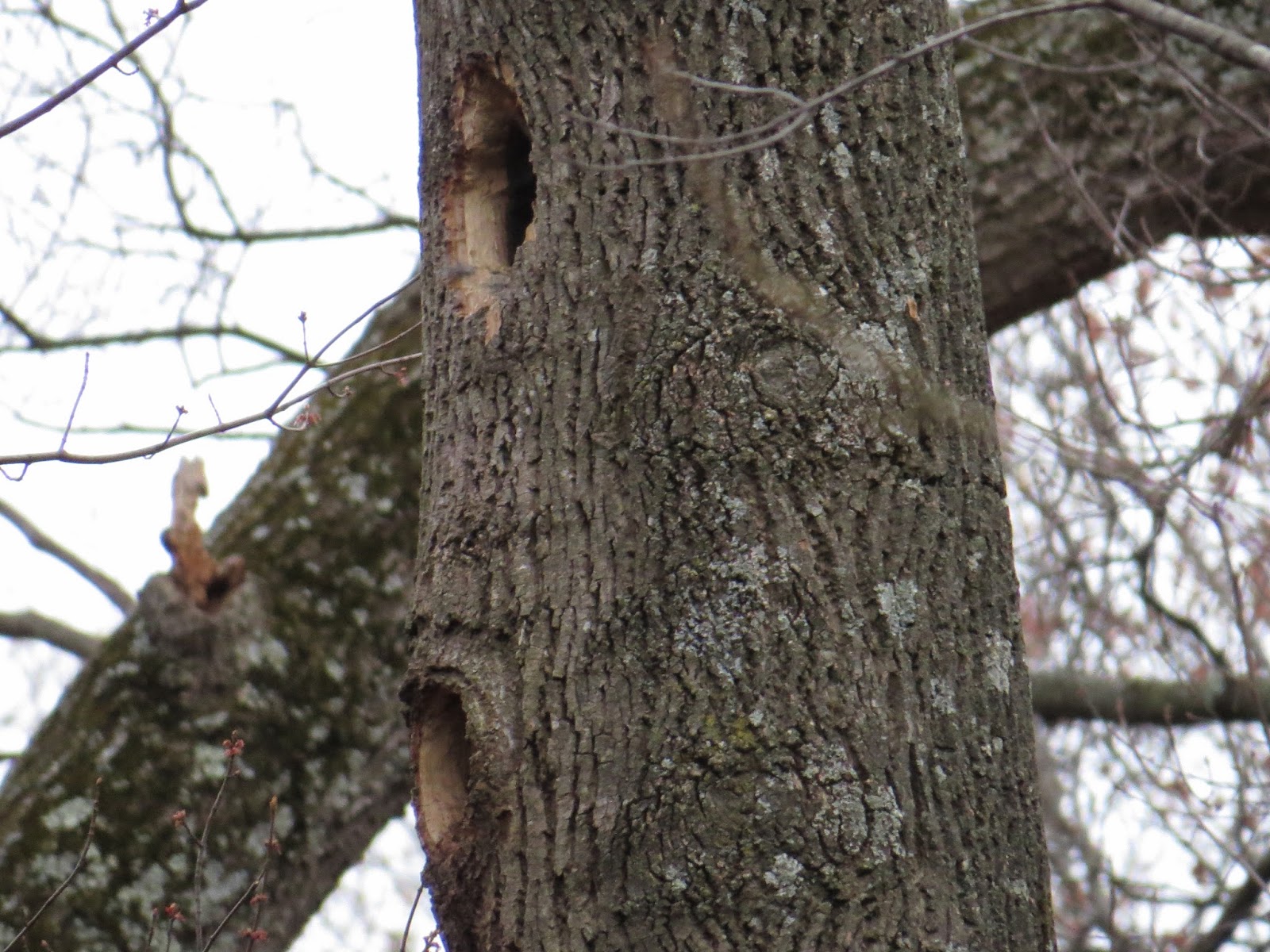
 And beside the mating pair are their oval shaped, large nesting holes.


So if you hear a loud "wuk wuk wuk" and large black and white woodpecker with a red tuft, it is a Pileated Woodpecker. And by the way cartoonist Walter Lanz used the Pileated to model for Woody Woodpecker.


Sometimes Pileateds will "drum" on your house, but they are not making a home, just calling to a mate. They really don't want to live in your house, they just want someone to love, and they want you to give them suet but they are happy eating beetles and other insects from trees!

(all photographs taken in Raymondale, Luria Park and Fairview Park)

Why a Raymondale bird blog? Dan and Beth Fedorko have been inventorying birds for Cornell University's Backyard Bird Count (www.feederwatch.org) which runs November through April each year. This inventory keeps track of migratory patterns, possible diseases, and decline and increase in bird populations. In response to the Raymondale Environmental Stewardship Task Force, we have started this blog which is separate from the general Raymondale news blog and more personal, to share our finds and photographs. If you see any birds in the neighborhood and surrounding parkland, please send us a photo! We'll help you identify it and might even post it on the blog!