This morning, March 4th, after a covering of heavy spring snow, I observed a pair of Eastern Bluebirds perched near our suet feeder. This was a first for us, having Bluebirds in our yard. We have observed them in Luria Park where there are nesting boxes set up around the perimeter. Bluebirds do not usually come to feeders unless meal worms are offered. Our meal worm feeder is currently empty as we usually fill it later in spring hoping to attract Warblers.
So, imagine my surprise at seeing this pair so very interested in our offerings. They couldn't access our suet feeder as it's designed for Woodpeckers and smaller songbirds. So I cut a piece of suet into small bits and laid the pieces along the deck railing. All the while the male Bluebird was watching me from a nearby branch. As soon as I went inside. The female Bluebird swooped down and gobbled as much suet as she could until the male scared her away and had his fill.
I hope that this pair will make a nest near our yard and visit our meal worm feeder. Fingers crossed! Here are photos I took of the male and female Eastern Bluebirds who visited us this morning.
Friday, March 4, 2016
Friday, January 22, 2016
The Birds of Winter Storm Jonas
With the gentle snow falling on Friday, the first day of Winter Storm Jonas, the birds were very active in our backyard feeders and heated birdbath. I took these photos through our kitchen and dining room windows in the later afternoon and thought you would like to see them.
A Carolina Wren perches on a metal rooster. These active little birds are not as perky in the winter snow.
They puff up so much. This wren is content eating the seed that falls on the deck or the ground.
The Dark-eyed Junco, a bird who prefers to spend winter here rather than Maine or Canada, waits for his turn at the thistle seed feeder. He doesn't seem to mind the snowflakes on his face.
And when not eating thistle seed, the Dark-eyed Junco enjoys the heated bird bath.
This male Downy Woodpecker hides out below the deck railing waiting for his turn at the suet feeder.
The female Downy Woodpecker also waits for her turn to enjoy suet which is great for birds during winter!
A Carolina Wren perches on a metal rooster. These active little birds are not as perky in the winter snow.
They puff up so much. This wren is content eating the seed that falls on the deck or the ground.
The Dark-eyed Junco, a bird who prefers to spend winter here rather than Maine or Canada, waits for his turn at the thistle seed feeder. He doesn't seem to mind the snowflakes on his face.
And when not eating thistle seed, the Dark-eyed Junco enjoys the heated bird bath.
This male Downy Woodpecker hides out below the deck railing waiting for his turn at the suet feeder.
The female Downy Woodpecker also waits for her turn to enjoy suet which is great for birds during winter!
Tuesday, January 19, 2016
Winter Birding In Raymondale: The Brown Creeper
Winter birding can be "easy" birding because you don't have foliage to hide the birds. Granted the birds are fewer this time of year, and their plumage isn't generally as brilliant, but we do have some birds here in winter that don't stay here in the warmer seasons. The Dark-eyed Junco and the White-throated Sparrow as well as the more elusive Golden-crowned Kinglet are our winter visitors. But a smaller bird that we have seen in our back yard hopping up the oak trees is the Brown Creeper.
Winter is a great time to spot this 5 inch long bird. They spiral up the trunks of the biggest tree they can find, probing in the bark for tasty insect larvae. They always move with their head up, unlike the White-breasted Nuthatch which prefers to glean food while going headfirst down the tree. The Brown Creeper is solitary and you won't find them in flocks. So keep your attention on the tree trunks and if you see movement it may very well be a Brown Creeper!
Monday, July 6, 2015
Excitement on Arnold Lane
Around 8 p.m. on Monday, July 6th, Sarah, Dustin, and Helen of Add Drive alerted us to a large bird up high in an Arnold Lane tree. Upon initial inspection we thought it may be a bittern, but doubts circled as bitterns are a marshy bird and not usually found high in tree tops.
After a little research we concluded that the bird perched up on a snag over Arnold Lane was a juvenile Green Heron.
This time of year there are lots of young birds fully fledged from their nests and the Green Heron is no exception.
This youngster gave us quite a display in the meager setting sunlight through the rain clouds. He stretched his wing and neck, looked all around.
Beautiful stripes and pointy crest.
More wing stretching before flying off in the direction of Woodley Pool, where we suspect he may have a membership and was seeking a place to wade :)
After a little research we concluded that the bird perched up on a snag over Arnold Lane was a juvenile Green Heron.
This time of year there are lots of young birds fully fledged from their nests and the Green Heron is no exception.
This youngster gave us quite a display in the meager setting sunlight through the rain clouds. He stretched his wing and neck, looked all around.
Beautiful stripes and pointy crest.
More wing stretching before flying off in the direction of Woodley Pool, where we suspect he may have a membership and was seeking a place to wade :)
Thursday, May 28, 2015
Bird Spotting!
A couple of weeks ago, deep in the woods behind the homes on Add Dr. the wildlife folks from Fairfax County installed a camera to record a fox den. The mama fox and her kits gave them quite a show but an unexpected visitor cruised through and gave us reason to add yet another bird to the neighborhood checklist (updated versions now available on the Luria Park kiosks). Check out this camera ready Wild Turkey strolling past the fox den:
This a Wild Turkey hen. These birds, considered by many to be game birds, have excellent eye sight and hearing. They are smart and they are very wary of humans. We are so lucky to have them living near us! If you see one you are very fortunate indeed!
And two of our younger naturalists, Grace and Martha, of Add Drive were strolling around the pond at Fairview Park. They forwarded me these wonderful photos of a noble Great Blue Heron fishing by the edge of the pond:
It is such a thrill to have our neighborhood school-age children so interested in our natural world! If you have any photos you would like to share please pass them along! I will do my best to get them posted. Happy Birding!
This a Wild Turkey hen. These birds, considered by many to be game birds, have excellent eye sight and hearing. They are smart and they are very wary of humans. We are so lucky to have them living near us! If you see one you are very fortunate indeed!
And two of our younger naturalists, Grace and Martha, of Add Drive were strolling around the pond at Fairview Park. They forwarded me these wonderful photos of a noble Great Blue Heron fishing by the edge of the pond:
It is such a thrill to have our neighborhood school-age children so interested in our natural world! If you have any photos you would like to share please pass them along! I will do my best to get them posted. Happy Birding!
Monday, May 11, 2015
He's Back: the Yellow-crowned Night Heron
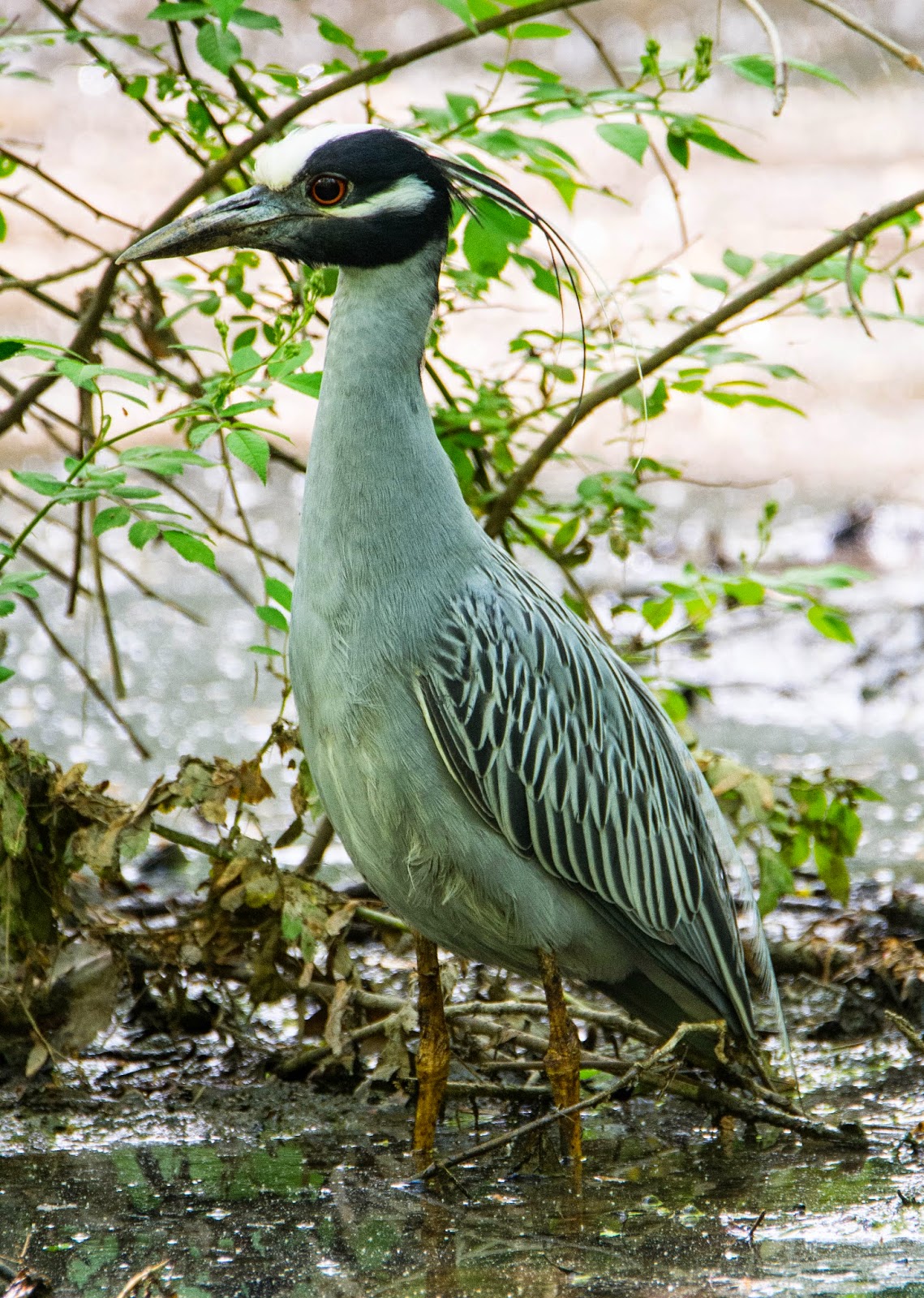
We saw the Yellow-crowned Night Heron today, Monday, May 11 this afternoon hunting crayfish in the brush-dammed stream between the bridge and Raymondale side of Luria Park.
This large-sized wader spend his winters on the coasts of Mexico, Central and South America. Our park is on the edge of their breeding range so this fine fellow may be migrating through.
The bird stands very still while hunting so you should get a good look. The best times for viewing are early morning and late in the day when the shadows are deep.
An elegant bird, the Yellow-crowned Night Heron's main diet consists of crustaceans, like the crayfish found in our streams.
Be alert and you'll most likely see this wonderful bird!
This large-sized wader spend his winters on the coasts of Mexico, Central and South America. Our park is on the edge of their breeding range so this fine fellow may be migrating through.
The bird stands very still while hunting so you should get a good look. The best times for viewing are early morning and late in the day when the shadows are deep.
An elegant bird, the Yellow-crowned Night Heron's main diet consists of crustaceans, like the crayfish found in our streams.
Be alert and you'll most likely see this wonderful bird!
Tuesday, May 5, 2015
The House Wren
In Luria Park by the far entrance where Executive Road comes into the park, there was a commotion. A couple of birds were singing loudly this morning (May 5th). They sat on the Blue bird house and flitted in and out of the brush. This small group of little birds with a big voice are the House Wrens living in our park.
The House Wren differs from our more common Carolina Wren in that they are smaller and do not have a distinctive eye stripe. These House Wrens in Luria Park have bred and the chicks are beginning to leave the nest as I observed a young one on the edge of the brush.
So, look for these small active birds with a really big voice. The House Wren!
The House Wren differs from our more common Carolina Wren in that they are smaller and do not have a distinctive eye stripe. These House Wrens in Luria Park have bred and the chicks are beginning to leave the nest as I observed a young one on the edge of the brush.
So, look for these small active birds with a really big voice. The House Wren!
Subscribe to:
Posts (Atom)