Wednesday, February 15, 2017

More About Luria Park Red-headed Woodpeckers

Our Luria Park Red-headed Woodpeckers have attracted the attention of the local birding community. If you see folks in the park with binoculars you know why. And if you don't have a pair of binocs, you may want to get a pair as spring migration season is on the way and we'll host another late afternoon birding walk (date and time TBA).

In the meantime, here are some better photos I took recently of one of the Red-headed Woodpeckers who live near the Raymondale end of Luria Park.


Sunday, February 5, 2017

Red-headed Woodpeckers in Luria Park

On the Raymondale side of Luria Park, to the left of the entrance, high on a tree snag is what we are pretty certain is a Red-headed Woodpecker nest cavity. Today we observed two RHWO in and around a hole near the top of the snag. A Red-bellied Woodpecker challenged the Red-Headed Woodpecker but didn't encroach on the cavity.

The snag is up very high so getting super clear photos even with a long lens was a challenge.

Here is a RHWO in the nest cavity. The bird was in here for a very long time.

The same bird fully emerged from the cavity. We are hoping that this spring brings us RHWO chicks! This cavity will be monitored on a regular basis. The population of the RHWO has declined drastically in the past fifty years due to habitat loss. They prefer dead old and tall oaks with a forested under story. Luria Park certainly has that! They are omnivores and will catch flying insects with great skill. They will store acorns and seeds in tree bark or the shingles of houses. They will also raid bird's nests for eggs or baby birds.

You will know they are near because they like to chatter. Just look up!


Wednesday, October 12, 2016

Red-breasted Nuthatch: Winter Visitor

This afternoon, October 13th, we saw for the first time in our yard, a Red-breasted Nuthatch. He was flitting around our half dead dogwood tree by the street. I managed to get one decent photo for you of the distinctive head stripes and orange breast.

This little bird with a stumpy tail is one of our winter birds. They have been coming to the area about a week and some will over winter here. They will come to your suet feeder. A wonderful little bird who finds our winters warmer than in their Northern Canada breeding ground!

Sunday, September 11, 2016

Yellow-billed Cuckoo In Luria Park

Early this morning in hopes the humidity was less we headed out to see any fall migrating birds heading south. We spotted a Yellow-billed Cuckoo in the maple tree by the bridge in Luria Park.

The Yellow-billed Cuckoo is one of our summer birds spending winter in South America. They like to stay hidden in the tree canopy preferring to remain very still unless they are foraging for caterpillars. They prefer large hairy ones like tent caterpillars.

They are a large slim bird about 11 inches long. They have a distinctive long black and white tail. They will perch with shoulders hunched to disguise their bright white underparts while they look for tasty fat insects.

Exciting to see this elusive bird in Luria Park. Fall migration is in full swing and you may very well see some unusual birds on their way south.

We also saw a Brown Thrasher gobbling down the fruit from a tree by the bridge.
These large thrushes will migrate to Georgia and Florida for the winter. And this fellow was fueling up for his journey!


Monday, July 18, 2016

Our Backyard Birds in Summer

Recently Sanny Wroblewki and Whitney Redding sent me photos of some summer bird action on Add Drive.

Whitney carefully got this shot of the new House Wren hatchlings sleeping in a stroller pocket. Soon these fuzzy cuties will be singing in the trees!

Sanny got this shot of a male Goldfinch enjoying black-eyed Susan seeds. Please keep any plants that have gone to seed in your yard for a while before deadheading them. The songbirds love the seeds!


Monday, June 27, 2016

Birds Lay Eggs in the Strangest Places

The Cogbills on Add Drive returned home from vacation to discover that they could not use their stroller which was left outside near their house. This is why...

A House Wren had decided that the stroller was a great place to lay eggs! According to Cornell Lab of Ornithology House Wrens usually nest inside tree holes and nest boxes. As the season progresses their nests can become infested with mites and other parasites that feed on the wren nestlings. Perhaps to fight this problem, wrens often add spider egg sacs into the materials they build their nests from. In lab studies, once the spiders hatched, they helped the wrens by devouring the nest parasites.

Here are two photos of a House Wren I took at Luria Park.

This little bird weights as much as two quarters. It will fiercely compete for a likely nesting site with loud vocalizations and pecking much larger birds. They are one of our summer birds and will migrate to South America in the fall.
Thanks to the Cogbills for forwarding the nest photo and for protecting our song birds!

Wednesday, June 15, 2016

Bird Feeders and Domestic Cats

Hello!~~

We all love our songbirds and our pet cats. Our cats love the songbirds too. Really love them. In their mouth.
Recently several neighbors have told me that they have found the remains of birds in their backyards by their bird feeders and have seen a cat or two in the vicinity. Now songbirds are prey for raptors, squirrels, fox, and raccoon, but by far the domestic cat is one of the major reasons we lose so many birds.
Song birds have a tough enough time in this big world of ours and we can certainly help them along by feeding them and by keeping our pets (cats and dogs) under our control. This time of year is an especially vulnerable time for songbirds as there are many many fledglings, young birds, who are easy prey.
This is not to say you must keep your cats indoors if that is not your inclination. If you allow your cat to prowl finding his or her inner tiger or lion, that's fine, but please put a bell or other noisemaker on your cat's collar. And if at all possible please bring your kitty in at night.
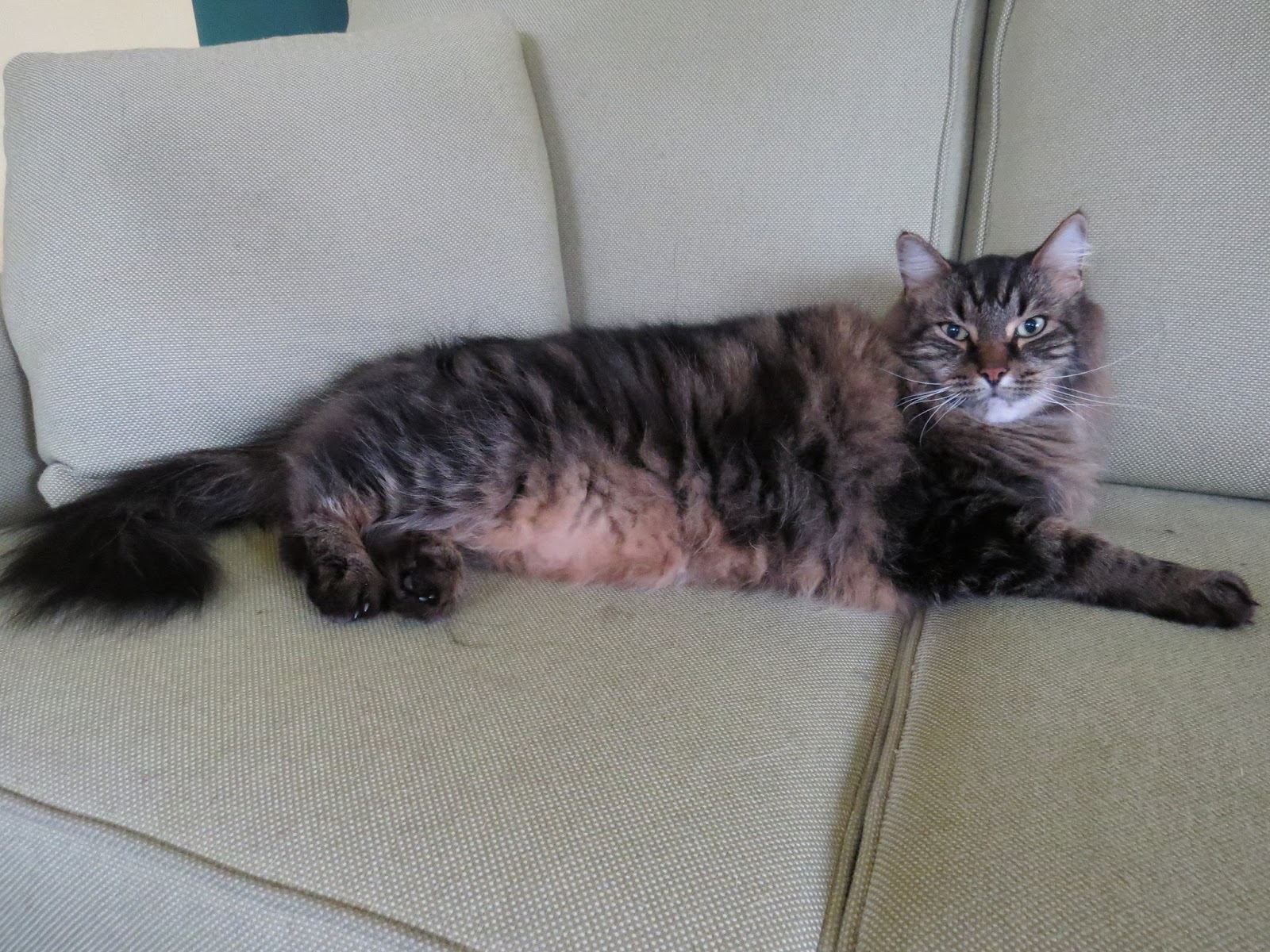
Our big cat, Gyro, is an indoor kitty and he has full access to all windows and supervised access to the deck where he can watch birds, squirrels, and chipmunks to his heart's delight. His instincts cause him to "chatter" when he sees a tasty treat with feathers but he must contend himself with his kitty chow and myriad of cat toys.


For further information please see this great article by The Wildlife Management Institute.