On Saturday morning, April 29th, Dan and I walked the boardwalk at Luria Park just off the footpath and up to the first (smaller) bridge. We didn't go much farther than that as we were content to observe all of the migrating birds in that small area. The tree canopy was nearly full which provided a cool shade from the climbing temperatures and sunshine.
We saw several birds for the first time in the park!
This is the Northern Waterthrush. He likes to forage on the damp ground, and in between was singing his little heart out. Notice the bold eye stripe and longer legs compared to his rotund body shape.
Here is the Ovenbird, so named because of the dome shape of their nests on the forest floor. He has a large eye with bold white monocle. He forages on the forest floor, strutting like a little chicken in the leaves.
What got us really excited was this bird singing up in the tree canopy between earnest foraging under the leaves: the Blue-winged Warbler. Notice his small dark black "mask" and dangerously sharp beak. He also has two white wing bars on his blue-grey wings.
There are so many birds migrating to and through our neighborhood and park, so please go out and look. Binoculars will certainly help you study the details especially of the birds that are up high! Happy Spring!
FYI: Dan and I are happy to host another mid-May late afternoon mid-week Luria Park birding walk. We had such a great time last year and saw so many birds, that we thought it would be fun to do that again this year. Stay tuned for the day and time!
Saturday, April 29, 2017
Thursday, April 27, 2017
In Our Yard: The Indigo Bunting
Welcome Spring and all of the birds migrating to and through our neighborhood!
This afternoon, I happened to see a young male (and molting) Indigo Bunting in our pink dogwood tree. He foraged for insects on the underside of the leaves, and then rose up from the behind the pink blossoms like The Great Pumpkin. Then he gave me a good look at the rest of him and it was apparent that he was still molting away his winter plumage to his full on bright indigo blue!
The Indigo Bunting can breed in our area and wouldn't that be exciting!
This afternoon, I happened to see a young male (and molting) Indigo Bunting in our pink dogwood tree. He foraged for insects on the underside of the leaves, and then rose up from the behind the pink blossoms like The Great Pumpkin. Then he gave me a good look at the rest of him and it was apparent that he was still molting away his winter plumage to his full on bright indigo blue!
The Indigo Bunting can breed in our area and wouldn't that be exciting!
Wednesday, April 5, 2017
Oh, Say Can You See...A Bald Eagle in Raymondale!
On Tuesday, April 4th at one in the afternoon Mary and Mike Cogbill on Add Drive got excellent views of a Bald Eagle perched about 35 feet up in a tree in their next door neighbor's yard. To Mary the bird looked like it was just resting or sleeping.
We have seen Bald Eagles flying over Fairview Park but never one roosting in our neighborhood forests. Mary and Mike were quite fortunate indeed!
Early Wednesday morning, I was birding in Luria Park and heard Red-shouldered Hawks screaming in the direction of Add Drive. A minute later I saw a Bald Eagle flying from the Add Drive direction and over Luria Parka and out of sight. Most likely the Bald Eagle roosted over night on Add Drive.
Keep those great bird photos coming! And a big thanks to Mary and Mike Cogbill!
As a footnote, close examination of the photo revealed a chain ion the Eagle's leg, a small animal trap actually. If you see the Eagle again, please contact the following folks immediately and by phone:
The Wildlife Center of Virginia at 540-942-9453 and Virginia Department of Game and Inland Fisheries Wildlife Biologist Mr. Kevin Rose at 804-937-3193. They are handling all of the injured eagles in the state and if possible they will help this bird!
We have seen Bald Eagles flying over Fairview Park but never one roosting in our neighborhood forests. Mary and Mike were quite fortunate indeed!
Early Wednesday morning, I was birding in Luria Park and heard Red-shouldered Hawks screaming in the direction of Add Drive. A minute later I saw a Bald Eagle flying from the Add Drive direction and over Luria Parka and out of sight. Most likely the Bald Eagle roosted over night on Add Drive.
Keep those great bird photos coming! And a big thanks to Mary and Mike Cogbill!
As a footnote, close examination of the photo revealed a chain ion the Eagle's leg, a small animal trap actually. If you see the Eagle again, please contact the following folks immediately and by phone:
The Wildlife Center of Virginia at 540-942-9453 and Virginia Department of Game and Inland Fisheries Wildlife Biologist Mr. Kevin Rose at 804-937-3193. They are handling all of the injured eagles in the state and if possible they will help this bird!
Tuesday, March 28, 2017
Nesting Season!
Dan, Lisa Byrd, and I walked Luria Park this afternoon and saw evidence of nesting!
Here is a female Red-bellied Woodpecker excavating a nest cavity. We watched her tossing out beak-fulls of saw dust as she made her happy home.
This pair of Carolina Wrens spent a lot of energy packing the crevice of a large rotted stump with moss and leaves.
Looking forward to seeing the hatchlings later this spring!
Here is a female Red-bellied Woodpecker excavating a nest cavity. We watched her tossing out beak-fulls of saw dust as she made her happy home.
This pair of Carolina Wrens spent a lot of energy packing the crevice of a large rotted stump with moss and leaves.
Looking forward to seeing the hatchlings later this spring!
Tuesday, March 7, 2017
Forgaing for Buggy Delights
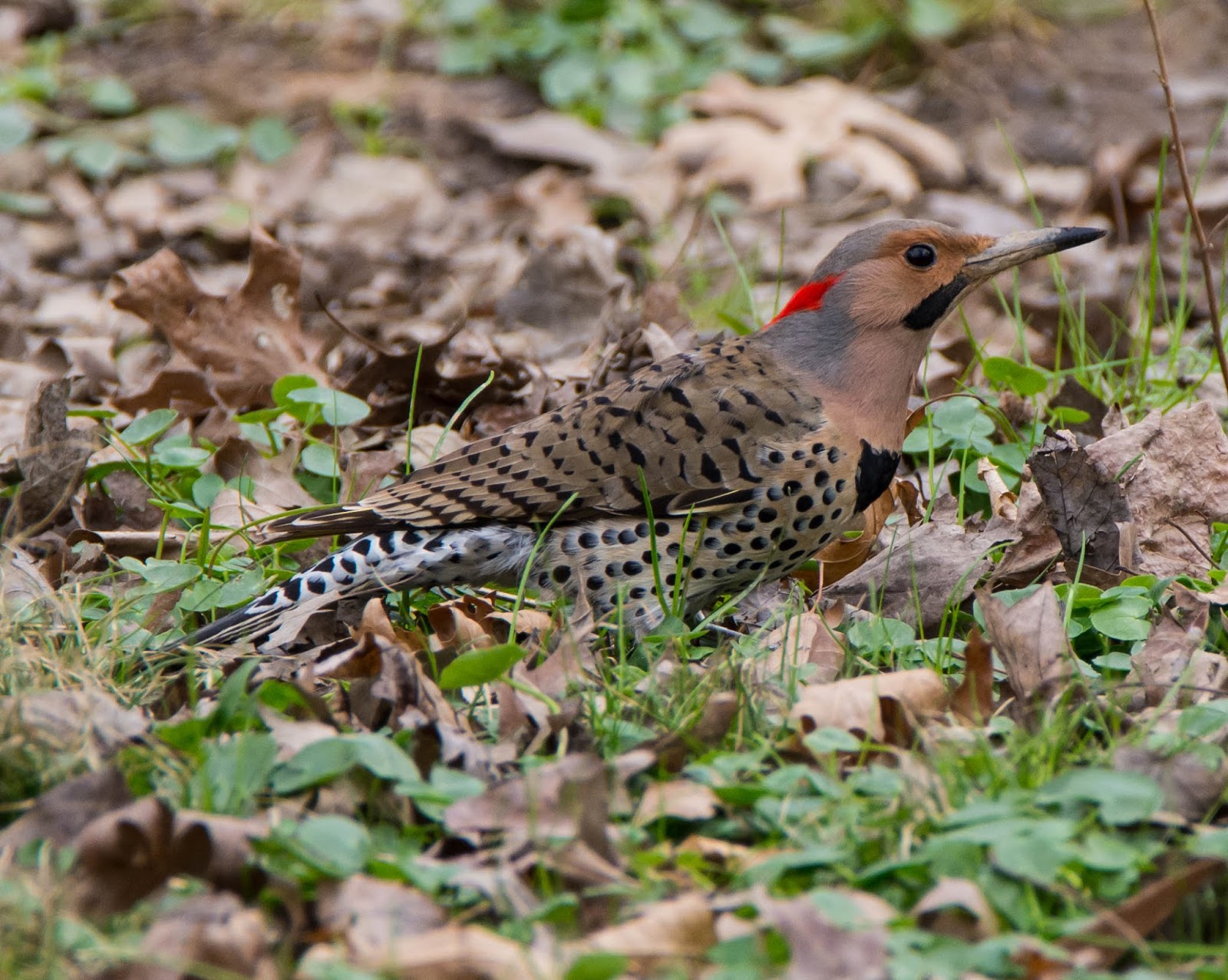
I spent a good part of the afternoon on March 7th in Luria Park near the Raymondale entrance. A lot of leaf flipping on the forest floor caught my eye. A male Northern Flicker was exuberantly thrashing about the leaf litter and probing the ground underneath.
Northern Flickers love to eat ants and ant larvae. They have a tongue that will stick out about two inches from the end of their beak to get the tasty insectiod treats. They feed primarily on the ground and while walking through the woods or any grassy area you could scare them up from the ground.
A few feet from the Flicker was a male Red-bellied Woodpecker also foraging.
He chose to hunt near a fallen rotted tree for his favorite food: spiders. They will also eat seeds and nuts. It is possible he is finding tasty arthopod or nut in this location.
All I know is I am glad I don't have to shove my face and tongue into the ground to get dinner!
A few feet from the Flicker was a male Red-bellied Woodpecker also foraging.
He chose to hunt near a fallen rotted tree for his favorite food: spiders. They will also eat seeds and nuts. It is possible he is finding tasty arthopod or nut in this location.
All I know is I am glad I don't have to shove my face and tongue into the ground to get dinner!
Thursday, March 2, 2017
Merlin in Luria Park
Late in the day on March 1st, we spied a slender silhouette darting above the tree tops like Top Gun fighter jet. The bird landed on a tall tree top to the north of the boardwalk in Luria Park and we got a nice view of it and identified the bird as a Merlin.
The Merlin is a smaller raptor that winters along the east coast before migrating north to breed in Canada. They like to eat birds and can catch them in mid-air. A fast and fierce raptor in a small 10-12 inch package.
Wednesday, February 15, 2017
More About Luria Park Red-headed Woodpeckers
Our Luria Park Red-headed Woodpeckers have attracted the attention of the local birding community. If you see folks in the park with binoculars you know why. And if you don't have a pair of binocs, you may want to get a pair as spring migration season is on the way and we'll host another late afternoon birding walk (date and time TBA).
In the meantime, here are some better photos I took recently of one of the Red-headed Woodpeckers who live near the Raymondale end of Luria Park.
Subscribe to:
Posts (Atom)